Thursday, November 29, 2007

Hiding Inside God

As we move toward Advent this Sunday, here's a wonderful poem by Rumi:


Before these possessions you love
slip away, say what Mary said
when she was surprised by Gabriel.

I'll hide inside God.

Naked in her room
she saw a form of beauty
that could give her new life.

Like the sun coming up,
or a rose as it opens,
she leaped, as her habit was,
out of herself into the presence.

There was fire in the channel of her breath.
Light and majesty came.

I am smoke from the fire
and proof of its existence,
more than any external form.


(The poem is Colin Barks’ translation. The painting is by Henry Tanner.)


Tuesday, November 27, 2007

Phantom

Last Wednesday, Kathy and I took Becca and a friend to the Westchester Broadway Dinner Theater to see Kopit & Yeston’s Phantom. The food there is always mediocre at best—my filet of sole was so hard that I couldn’t even cut through a lot of it—but I’ve never seen this version of Phantom (rather than Andrew Lloyd Webber’s Phantom of the Opera) performed anywhere else. Kopit & Yeston’s rendition of Leroux’ Phantom story—written just before Webber wrote his—is a touching version, humanizing the phantom, Eric, and providing interesting background connections with the Opera itself and the people who work in it. On top of that, the scores and lyrics are much better than Webber’s. I love, for example, the way in which the William Blake poem is put to music and used to capture some insights into who Eric truly is.

I’d last seen this play performed more than 10 years ago, also at the Westchester Broadway Dinner Theater. The set—a strong point in WBDT productions—was basically the same as it had been then. Sandy Rosenberg played La Carlotta in an entirely different, but equally humorous, way than Meg Bussert did back in the 90s. Richard White’s earlier version of Eric was much stronger than that of Aaron Ramey, who tends to ham up his death by flopping around on the stage. Still, if you ignore the bad food that comes with it, I’d choose this performance over Webber’s stage production or film any day!

Monday, November 26, 2007

The Last of...


This weekend we used up the very last of the fruits and vegetables we'd grown in our garden this summer and stored in the freezer. We made a green-red pepper jelly that's very hot and, at times, also sweet. It's much too spicy for me, but Kathy seems to be enjoying it on crackers or toast as long as there's lots of cream cheese with it to cut some of the heat. And the red and green pepper pieces in the jelly make it look very Christmasy.

Tuesday, November 20, 2007

Bright Eyes at Radio City

Last evening we took Becca and a friend to Radio City Music Hall for the Bright Eyes concert (the last stop on his 2007 Cassadaga tour). The covers for Bright Eyes were the Felice Brothers and then Thurston Moore. The Felice Brothers came on about 8:15 and played several of their countryish Americana songs. I’d never heard of the group before, but apparently they are mainly three brothers (along with friend Christmas) who grew up in the Catskills and began playing together. What was surprising in their music was the instrument that brother James Felice played—the accordion. I don’t think of that as being an instrument in a modern country/rock band, but it was and it worked well with the music being performed.

When they finished (around 9) there was a break and then Thurston Moore and his band came on to play. Moore is about my age and used to play with Sonic Youth before setting out with his own band. I’d heard a song or two of his from his mid-90’s Psychic Heart album and had never much liked its loud, abrastic rock music (Kathy’s description of it was acid rock), but things I’d read online had said he’d moved toward more folksy, more acoustic sounding performances. Well, if he has, we saw very little of it last night. I couldn’t wait for him to get off the stage.


There was another long, long break and a little after 10, Colin Oberst and his Bright Eyes band finally appeared. I only know a few of Bright Eyes songs, but from what I can tell most of the ones performed in last night’s show were from his new album. Oberst is clearly talented—playing guitar (acoustic and electric) and piano as well as singing—but I’m not really sure I like most of his music. I was more taken with his trumpet player, Nate Walcott, whose music was a beautiful addition to several of Bright Eyes (and the Felice Brothers) songs. At 11 pm, Bright Eyes left the stage and the audience began cheering—half heartedly, it seemed to me, because they were busy looking at the pictures they’d snapped during the show—and at about 11:15 Bright Eyes came back on for what I assumed would be a song or two encore.

Instead the group performed until about midnight, doing some of their better known songs-- “Lover I Don’t Have to Love”, for example, was their first encore song—and then inviting the earlier bands back to perform with them on various songs. This addition to the show—in which Oberst also talked a bit—was much better than the show itself. Bright Eyes and the Felice Brothers did Neil Young’s “Walk On” as part of it and all three bands got together to perform Tom Petty’s “Walls” as a final number.

What amazed me most about the evening wasn’t Bright Eyes (or for that matter either of the other bands) but the audience. Throughout the show, most of the audience (90 % of whom I’d guess were in their teens and 20s) spent huge amounts of their time taking pictures and making videos with their digital cameras and cell phones. In many of these pictures the bands were so small that I’ve no idea what they would possibly do with them afterwards. Rather than losing themselves in the music, singing with it, or moving with the melody, what most of the folks around me seemed to be doing was concentrating on what they were seeing through their electronic equipment. To me, it was a whole new way of attending a concert, one I’m not quite sure yet what to make of.

Monday, November 19, 2007

Church in the World


I recently finished reading Brian McLaren’s new book Everything Must Change. In it McLaren seems to be taking the next step in his emerging church work, moving from an emphasis on those who will be in the church to what the church should be doing. He calls on the church to refocus the metanarrative of Jesus in a way that moves from an individualistic, “me and my soul on its way to heaven” approach to a more societal “me and my community involved in building the kingdom of God on earth” approach. This basic story would then move from being a place where we don’t focus on ourselves as imperfect and the world around us as something bad to be afraid of, but on ourselves as hopeful, creative changing people of God who live in a benevolent world that provides for our basic needs if we’ll let it.

McLaren critiques the theocapitalist worldview that the modern church has taken, emphasizing its four laws:

1)progress through rapid growth;

2) security through possession and consumption;

3) salvation through competition alone; and

4) freedom to prosper through unaccountable corporations.

Then McLaren contrasts those laws with Jesus’ gospel:

1) the law of good deeds for common good, where the aim is not to build up capital but to emphasize care for people, especially the poor;

2) the law of satisfaction through gratitude and sharing. In this section McLaren shows how, beginning with the primeval narratives in Genesis, evil and consumption are closely linked. (Adam and Eve, says McLaren, get in trouble for wanting and then consuming the fruit. Abel and Cain get into a class war based on kinds of consumption. Etc.) Gratitude in contrast, becomes an act of defiance, celebrating not what we want to consume but what we have and are content with.

3) the law of salvation through seeking justice; and

4) the law of freedom to prosper by building better communities.

Toward the end of the book he also does a nice refocusing of the New Jerusalem away from a “the world is bad, we’ve got to end it and start over” apocalypse toward a more transformative eschatology.

I didn’t find much that was new in McLaren’s book, though I agree wholeheartedly with much of his argument. What I did find, as I read, however, was a yearning for the presence of congregations that were consistently speaking to the overconsumption crisis. Especially during this church stewardship season, they seem so rare, that I find myself wondering what would happen if congregations put even half the energy that they put into raising funds for their budgets into doing similar work on combating overconsumption.

Sunday, November 18, 2007

One Down, One Up

On Friday evening I went to see the movie Lions for Lambs, the film Robert Redford directed which stars (along with Redford) Tom Cruise and Meryl Streep. Reviews I’d read had agreed that it was heavy on a liberal view of the war against terrorism, but had given ranged in evaluations from it’s being “a well-made movie” asking “many important questions” to it’s being a “preachy, immobile” film. What I was hoping for in the film was that it would begin to examine the issues with a depth beyond the two party Republican-Democrat, hawk-dove position – either something more along the lines of a “Wag the Dog” type film or a new way to approach the current political situation.

What Lions for Lambs turned out to be was more of a series of talking heads –Cruise (a young conservative) lecturing Streep, Redford (playing a college professor) lecturing a student—with some scenes showing an attack on Afghanistan interspersed, all in an attempt to deliver a tired, liberal message that has already been presented too many times. The acting wasn’t great. Cruise didn’t even stand the way those who have graduated from West Point do, much less present any depth to his conservative position. And when Redford asked the student he was lecturing in his office why the young man had stopped attending class and why he wasn’t more actively involved in the political science discussions and in volunteering, I kept wanting to answer for him “because you’re a rambling, boring old fool who has no connection with the realities of today’s world and so why would I waste my energy on you or what you’re suggesting I do!” Each time Redford took a breath and began a new part of the (one-sided) conversation, I had all I could do to hold myself in my chair rather than, on behalf of the student, walking out of the lecture and the theater.

Luckily, as I left the movie theater, I kept in mind that on Saturday afternoon I would be going down to Manhattan’s Second Stage Theater to see Peter and Jerry, a play in which Edward Albee pairs two of his one acters—Homelife, a piece written in 2001, with Albee’s first real play The Zoo Story (perhaps my all-time favorite Albee work, though much more recently written The Goat is a close runner up), written in 1958. Albee and his caustic wit would surely cure me of the blasé feeling I carried away from Lions for Lambs.

Homelife in many ways seemed to me a toned down version of Who’s Afraid of Virginia Woolf? with a husband (Peter) and wife (Ann) politely exploring how their lives spent in an Upper West Side bourgeois setting have been civilized, predictable, complacent, and—when push comes to shove- much less than satisfactory, at least for the wife. Ann explains to her husband that he is "gentle, and thoughtful, and honest, and good -- oh, that awful word!” and that she yearns once in a while to experience the chaotic, animal madness she hopes still survives somewhere inside this bland, nice man she’s been with for years. Albee means for Homelife to explain and deepen the character of the “vegetable” Peter who is fairly silent through most of The Zoo Story. While I’ve never felt the need for such an explanation—leaving that to the details Albee provided in the Zoo Story such as the pipe and Peter’s job publishing texts had always seemed enough for me—it makes what was a subtext of the older play much more explicit.
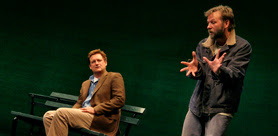
Does it work? It does, though Homelife is much weaker than the strong writing in The Zoo Story. And, though Bill Pullman (who I thoroughly enjoyed back in 2002 as the lead in The Goat, playing Peter in both acts) and Joanna Day (Ann) are both excellent actors, Dallas Roberts as Jerry takes the day. At one point during the beginning of his story-telling of “Jerry and the Dog”, the cell phone of someone in the audience went off and Roberts stopped, keeping up the energy of his semi-psychotic, prowling character while glaring toward the sound until the ringing stopped. Because of Roberts’ powerful acting and the much more highly charged interactions in The Zoo Story, Act 2 of Peter and Jerry is what makes the performance memorable and worthwhile!

Friday, November 16, 2007

Summer in the Catskills


In between meetings this morning, I spent my time enjoying the new exhibit of oil paintings in the Donald Gallery at my church. Entitled "Summer in the Catskills", it's a collection of landscapes done by local artist June Sidman, including the two above entitled "summer field" and "Phoenicia". The opening for Sidman will be this coming Sunday with her paintings staying up in the Gallery through mid-January. I'm looking forward to having a chance to live with them for the entire holiday season!